| The notice and comment process typically takes months—which means that if Summerhays' order stands, the U.S. will have to continue to invoke Title 42 to expel migrants. But the U.S. Department of Justice (DOJ) says it will appeal.
"The Centers for Disease Control and Prevention (CDC) invoked its authority under Title 42 due to the unprecedented public-health dangers caused by the COVID-19 pandemic," DOJ said in a statement. "CDC has now determined, in its expert opinion, that continued reliance on this authority is no longer warranted in light of the current public-health circumstances."
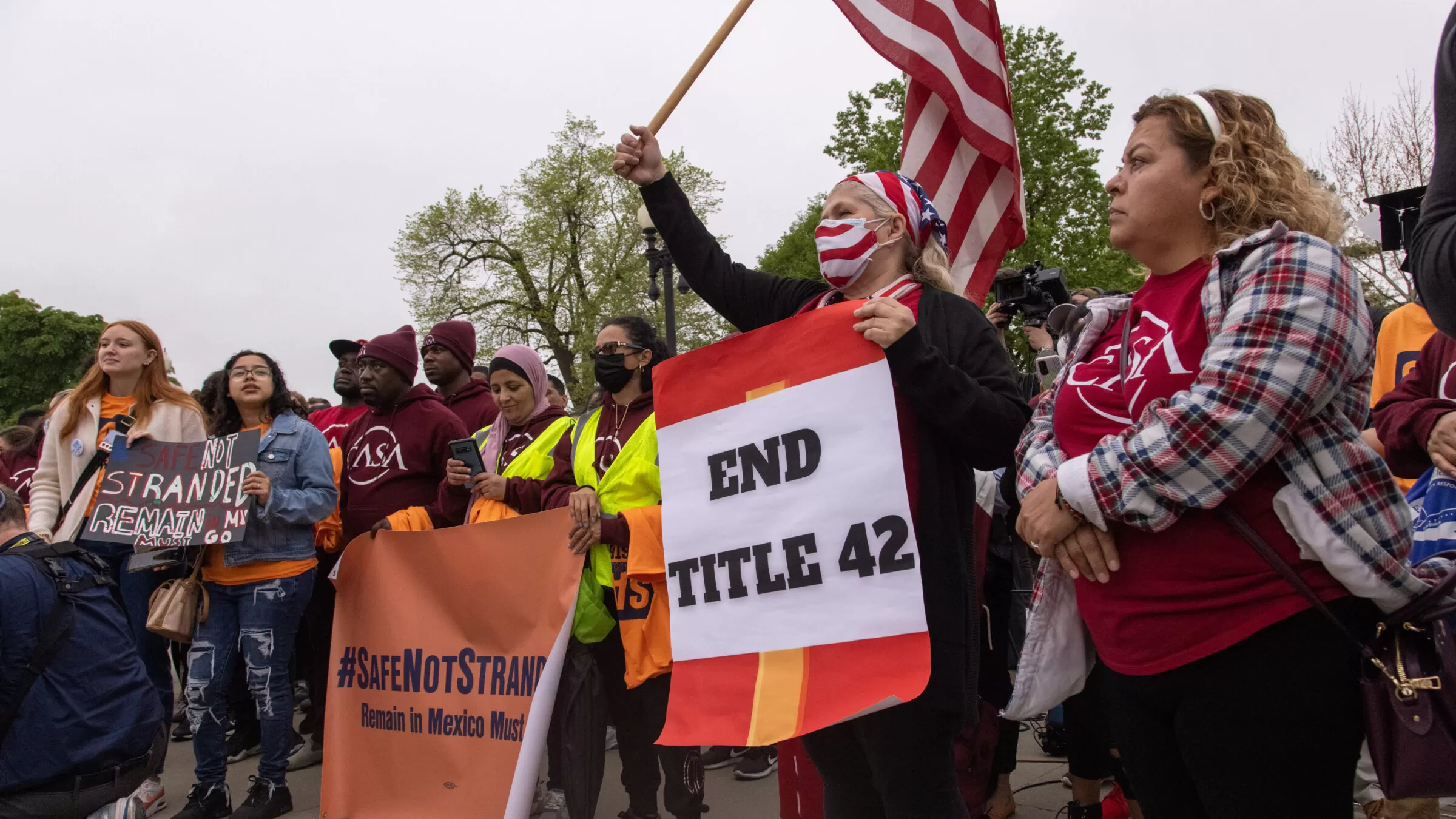
Title 42 of the Public Health Safety Act was first invoked as a means to keep out migrants by the Trump administration, back in March 2020. And—despite campaign promises to stop Trump-era immigration policies—President Joe Biden continued to extend this policy.
Last September, a federal court said the Biden administration could not keep doing so when it came to migrant families and issued a preliminary injunction to stop this. The administration appealed.
In March, the U.S. Court of Appeals for the District of Columbia Circuit upheld the lower court's preliminary injunction in part, saying that the CDC didn't have the authority to require the expulsion of refugee seekers back to countries where they were likely to be tortured or persecuted based on their "race, religion, nationality, membership in a particular social group, or political opinion."
"The case is enormously important because of the vast number of migrants expelled under the CDC order (over 1 million and counting), and because of the broader implications for the power of the executive branch over immigration policy," wrote George Mason University law professor and Volokh Conspiracy blogger Ilya Somin in March. "If the government had prevailed on all points in this case, CDC would have virtually unlimited power to expel any migrants from anywhere, anytime it wants."
Under the D.C. Circuit Court's ruling, "many - perhaps even most - of the people currently targeted for Title 42 expulsions cannot be expelled immediately," noted Somin.
Meanwhile, the Biden administration had exempted unaccompanied minors from Title 42 expulsion. But Texas sued, and the U.S. District Court for the Northern District of Texas ruled in the state's favor.
In response, the CDC announced that it was "terminating with respect to unaccompanied noncitizen children an Order under Title 42 suspending the right to introduce certain persons into the United States. In effect, this means that unaccompanied noncitizen children will not be expelled from the United States under CDC's order."
Then, in April, the CDC said that it would lift the Title 42 expulsion order altogether.
"[The] CDC has determined that a suspension of the right to introduce such covered noncitizens is no longer necessary to protect U.S. citizens, U.S. nationals, lawful permanent residents, personnel and noncitizens at the ports of entry (POE) and U.S. Border Patrol stations, and destination communities in the United States," the agency stated.
But the attorneys general of Arizona, Louisiana, and Missouri filed a suit to stop this, saying ending the expulsion order would lead to "unmitigated chaos and catastrophe."
The suit was later joined by the attorneys general of Alabama, Alaska, Arkansas, Florida, Georgia, Idaho, Kansas, Kentucky, Mississippi, Montana, Nebraska, Ohio, Oklahoma, South Carolina, Tennessee, Utah, West Virginia, and Wyoming.
Before his latest ruling, "Summerhays had already issued a temporary restraining order barring the U.S. Department of Homeland Security (DHS) from starting to phase out Title 42 before the May 23 termination date," notes CBS News. | 



No comments:
Post a Comment