Visual Capitalist |
| How Far Are We From Phasing Out Coal? Posted: 28 Apr 2022 12:54 PM PDT
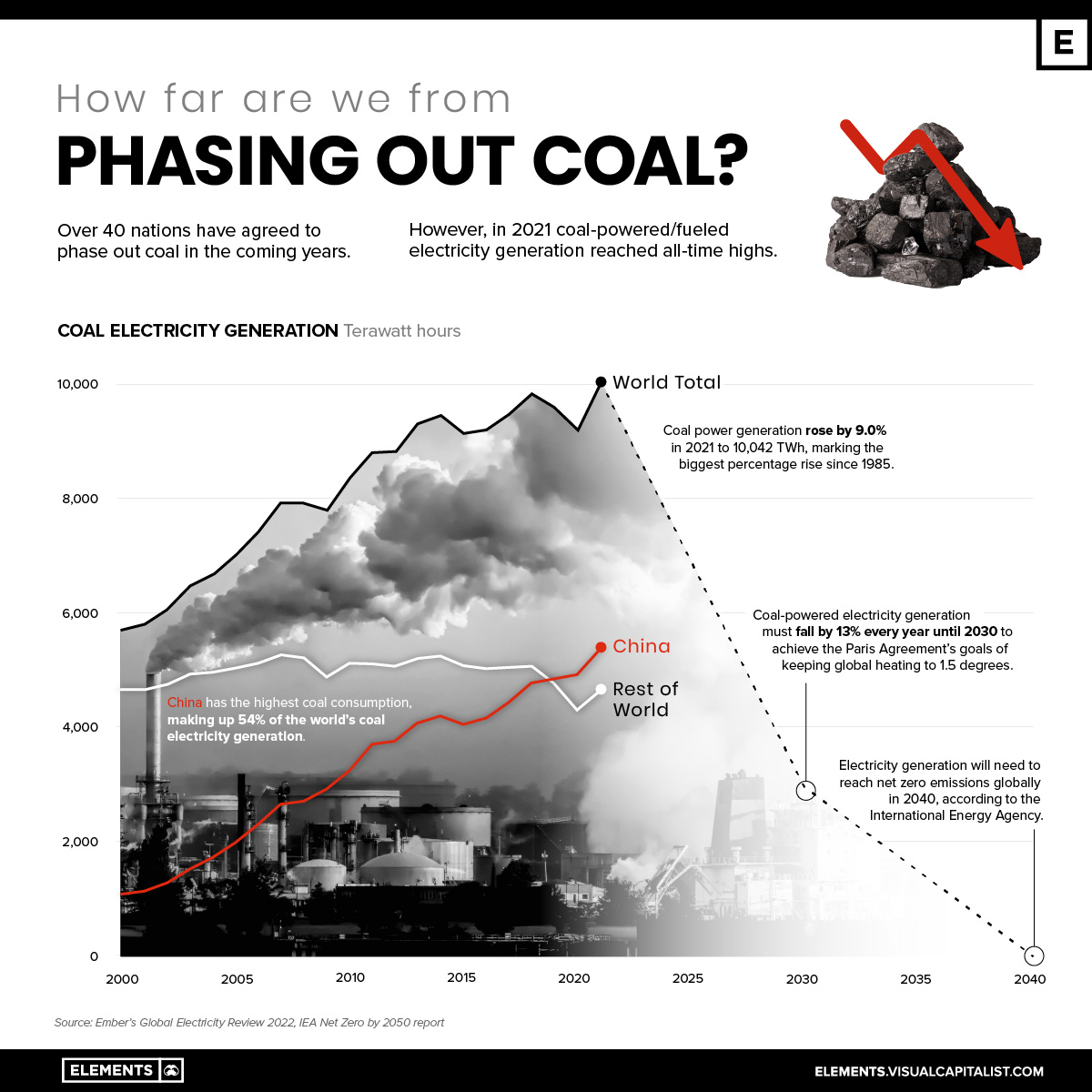
How Far Are We From Phasing Out Coal?This was originally posted on Elements. Sign up to the free mailing list to get beautiful visualizations on natural resource megatrends in your email every week. At the COP26 conference last year, 40 nations agreed to phase coal out of their energy mixes. Despite this, in 2021, coal-fired electricity generation reached all-time highs globally, showing that eliminating coal from the energy mix will not be a simple task. This infographic shows the aggressive phase-out of coal power that would be required in order to reach net zero goals by 2050, based on an analysis by Ember that uses data provided by the International Energy Agency (IEA). Low-Cost Comes at a High Environmental CostCoal-powered electricity generation rose by 9.0% in 2021 to 10,042 Terawatt-hours (TWh), marking the biggest percentage rise since 1985. The main reason is cost. Coal is the world's most affordable energy fuel. Unfortunately, low-cost energy comes at a high cost for the environment, with coal being the largest source of energy-related CO2 emissions. China has the highest coal consumption, making up 54% of the world's coal electricity generation. The country's consumption jumped 12% between 2010 and 2020, despite coal making up a lower percentage of the country’s energy mix in relative terms.
Together, China and India account for 66% of global coal consumption and emit about 35% of the world's greenhouse gasses (GHG). If you add the United States to the mix, this goes up to 72% of coal consumption and 49% of GHGs. How Urgent is to Phase Out Coal?According to the United Nations, emissions from current and planned fossil energy infrastructure are already more than twice the amount that would push the planet over 1.5°C of global heating, a level that scientists say could bring more intense heat, fire, storms, flooding, and drought than the present 1.2°C. Apart from being the largest source of CO2 emissions, coal combustion is also a major threat to public health because of the fine particulate matter released into the air. As just one example of this impact, a recent study from Harvard University estimates air pollution from fossil fuel combustion is responsible for 1 in 5 deaths globally. The Move to RenewablesCoal-powered electricity generation must fall by 13% every year until 2030 to achieve the Paris Agreement's goals of keeping global heating to only 1.5 degrees. To reach the mark, countries would need to speed up the shift from their current carbon-intensive pathways to renewable energy sources like wind and solar. How fast the transition away from coal will be achieved depends on a complicated balance between carbon emissions cuts and maintaining economic growth, the latter of which is still largely dependent on coal power. The post How Far Are We From Phasing Out Coal? appeared first on Visual Capitalist. | |||||||||||||||||||||||||||||||||
| Building Balanced Exposure to the Blockchain Economy Posted: 28 Apr 2022 08:05 AM PDT The following content is sponsored by MSCI
Building Balanced Exposure to the Blockchain EconomyBlockchain technology extends far beyond Bitcoin, Dogecoin, and other popular cryptocurrencies, as it provides a foundation for verifiable financial systems and proof of ownership for digital goods and assets. From privacy concerns to anti-trust issues, big tech has eaten away at the world's trust in the technology sector. As people search for better and more trustless solutions for their financial services, the blockchain economy is flourishing to meet their needs. This infographic from MSCI outlines how quickly decentralized solutions and services have grown, and how investors can be a part of this exciting new sector. The Three Key Trends of Blockchain AdoptionBy cutting out the need for a centralized middleman that facilitates transactions, blockchains can provide more efficient systems to power three key trends of the fintech future:
As the first cryptocurrency and deflationary monetary asset, Bitcoin is the ambassador for digital hard money. By having a fixed supply of 21 million bitcoin set in code and a decentralized network powering transactions on the network, Bitcoin provides anyone access to a deflationary digital asset that they can transfer in minutes without having to trust centralized intermediaries. While Bitcoin pioneered the blockchain revolution over the past decade, further functionality built on blockchain technology is enabling digital goods and collectibles with non-fungible tokens (NFTs) along with more equitable and trustless financial systems through decentralized finance. Decentralized Finance (DeFi) Makes Financial Services AccessibleAlong with seeking decentralized hard money assets in the form of cryptocurrencies like Bitcoin, the world is looking for trustless financial services through which they can borrow, lend, and perform other essential financial services. Decentralized finance (DeFi) enables these services through decentralized applications (Dapps) powered by smart contracts. Today, more than $260 billion is currently "locked" or engaged with some form of smart contract in a DeFi application. Below are the 10 largest DeFi applications by the amount of value currently "locked" or engaged with the applications' smart contracts.
Source: DeFi Llama From staking tokens within a protocol in exchange for governance votes to providing market liquidity by locking tokens up in exchange for a portion of trading fees, DeFi is providing functionality and incentives for participants in the blockchain economy. What is the MSCI Blockchain Index?The MSCI Blockchain Index was developed in collaboration with ARK Invest with the aim of representing the performance of a set of companies associated with the development of products and services for the blockchain economy. From providing payments services for cryptocurrencies to the actual hardware products used for verifying blockchains, these companies fall into five core segments of the digital blockchain sector:
With a broad variety of industries contributing to the blockchain economy, companies like AMD, Visa, and the Intercontinental Exchange (ICE) are among the top constituents of the index. As decentralized finance and other technologies bring about a trustless revolution for financial systems and the ownership of digital goods, the MSCI Blockchain Index ensures you aren't left behind. The post Building Balanced Exposure to the Blockchain Economy appeared first on Visual Capitalist. |




| You are subscribed to email updates from Visual Capitalist. To stop receiving these emails, you may unsubscribe now. | Email delivery powered by Google |
| Google, 1600 Amphitheatre Parkway, Mountain View, CA 94043, United States | |


No comments:
Post a Comment