Paul Boag - User Experience Advice |
| UX in Agile: How to Ensure UX and Agile Work Successfully Together Posted: 30 Sep 2021 04:00 AM PDT In theory, UX design and Agile should work seamlessly together as they both have the same aim. In reality, UX in Agile often proves problematic. In this post, I explain why that is and what we can do about it. Agile sucks! Okay, let me qualify that. The way most organizations implement Agile sucks, especially from a UX design perspective. These problems are not a reflection of the Agile methodology. Instead, it is the fact that few organizations have a culture that can embrace Agile at its best. In Principle UX Design in Agile Should Work Well TogetherWhen I first read the Agile manifesto I found myself enthusiastically nodding along. Even specific working methodologies like Scrum made sense to me.
were all music to my ears. These were things I could fully support as a UX designer. Yet over the years, as I worked with organizations that supposedly used Agile, I found that the reality for those engaged in UX design was frustrating. Why Real-World Agile SucksThe problem is that when most organizations say they use Agile, what they mean is that their development team uses Agile, but the rest of the organization doesn’t, and therein lies the problem. UX design only truly flourishes in Agile when Agile is being run organization-wide. That is because ‘development only Agile’ fails to embrace many of the principles of true Agile. In most cases, real-world Agile fails on several counts. Projects Are Formulated by ManagementAccording to the Agile manifesto, teams should be made up of both business people and developers. It also argues that teams should be self-organizing, agreeing together on a direction. However, this is rarely the case. Typically projects are still being initiated and broadly defined by senior management with no feedback from the team who will implement the project. 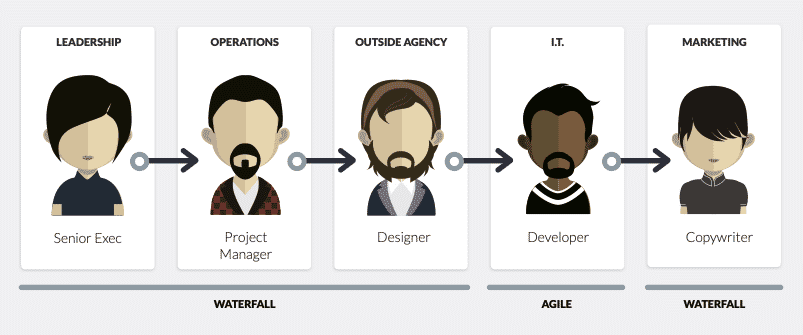  Put another way, UX designers are rarely involved in defining which projects should or should not happen. Moreover, they do not even define which projects should be prioritized. The user is rarely even considered in this early project phase. Projects Rarely Consider User NeedsThe Agile manifesto also says that “our highest priority is to satisfy the customer,” yet the type and scope of projects rarely draw upon robust user research. Instead, they are driven by internal politics, business strategy, and ego. Instead of the emphasis being on ‘user stories‘ as defined in Scrum, they are more often than not driven by features. Sprints Emphasize SpeedThe reason many management teams ’embrace’ Agile is because it promises faster delivery. However, it also emphasizes quality, yet that is overlooked. Instead, most sprints focus on speed over all else. As a result, teams are under pressure to turn around work so fast that there is little time for testing or iteration, despite quality being a core value of Agile. The MVP Becomes the Final ServiceAnother core value of Agile is continuous delivery. This principle means that the first iteration of a digital service is often the minimum viable product because the intention is to iterate that overtime to improve it. However, when the broader organization has failed to embrace Agile, there is enormous pressure to move on to the next project in the backlog. The result is that the MVP becomes the final service. That is partly caused by too many projects on the go, because there is no mechanism for assessing the value of potential projects. Project Teams Are UnbalancedAnother issue caused by real-world Agile and integrating UX design is that most service teams are unbalanced. This problem arises because the ratio between developer and UX designer is wrong. Most organizations have way more developers than UX designers meaning that any single UX designer is spread across multiple teams. This lack of UX designers means they are typically not consulted during the initial phases, and the user is not adequately represented during development. A Lack of Holistic ThinkingThe final problem with UX design in Agile is a characteristic of Agile itself, born from Agile being a development methodology. Agile focuses on rapidly delivering new features incrementally. Thus, the emphasis is on sprints and work packages. However, UX designers need to think holistically. They have to consider the end-to-end experience and the broader context, such as understanding the user at a deeper level. So how do we solve all of these problems? How do we ensure UX design and Agile can work together as intended. Ensuring UX Design and Agile Play NicelyThe obvious solution to all of this is to implement Agile organization-wide and as Agile was intended. However, that is easier said than done and still wouldn’t fix issues like a lack of holistic thinking or under-resourcing in the UX team. So instead, let’s look at what we can practically do to integrate UX design and Agile more effectively, beginning with defining the project. Define and Prioritize Projects Based on User ResearchYou will not stop management from coming up with an endless list of project ideas they want to see implemented. However, you might be able to control to some extent where they appear in your backlog with a system like digital triage. That is a system that includes the needs of users in the mix. You can also ensure that each project begins with user research to validate the idea and help shape what functionality it offers. This initial research can often be carried out as part of an initial sprint zero where the project’s scope is better defined. This period can also allow the UX designer to think holistically. Allow the UX and UI Designer to Look at the Bigger PictureAgile tends to be feature-focused, breaking a larger project into manageable work packages that deliver a subset of functionality. That makes sense for developers, but as I have already said, UX and UI designers need to consider how all the pieces of functionality work together. A sprint zero can provide this opportunity, but it will not be enough. The designer will need to step back every once in a while to ensure everything continues to hang together. One of the best ways of accommodating this is to have the occasional sprint that doesn’t focus on delivering new features but instead on tidying up what you already have. Doing so helps both designers and developers, giving them opportunities to take stock. Of course, this only works if you have enough UX designers to do this. Integrate UX Designers With Your Agile TeamsUnfortunately, you are probably not in a position to go out and hire a load more UX designers, so every team has a full-time designer. You will need to recognize that if the UX designer is not always around, the rest of the team also needs to ensure user needs are considered. That said, you should also include the designers you have a little and often throughout the project. Bring your designers in early and keep them in the loop throughout the project lifetime. Don’t presume they only need to be involved when you are initially designing the interface. They will have as much to offer in the early stages of defining the project and later when it comes to testing and iteration. That brings me on to iteration. Leave Room for IterationIn my experience, most sprints overcommit. In other words, the team agrees (or is forced) to deliver far too much in a single sprint. This overcommitment inevitably leads to testing and iteration being pushed out of the sprint, despite these being founding principles of Agile. We have to learn to commit to less in a sprint to integrate UX into Agile. Unfortunately, the introduction of velocity into Agile has further muddied the waters, emphasizing speed rather than quality. That has to change. It is also important to remember that this need for iteration does not end when the service launches. Ensure Every Service Has an Engaged OwnerEarlier I mentioned that most services are launched as MVPs and then largely abandoned. That occurs for two reasons.
The problem is that from a UX perspective, the post-launch phase is where UX designers can make the most improvements to the experience. That is because we will have more reliable data on how real users are interacting with the service. So to resolve this issue, we should not build services unless they have a product owner who will remain engaged for as long as the service is running and have the budget to support them. Of course, making that happen may well be above your pay grade. However, we should at least be raising the issue and pushing for a post-launch optimization plan. A Misunderstood ProblemThe relationship between UX design and Agile is much misunderstood. There is a perception that the two do not work particularly well together. However, that shouldn’t be the case. Instead, the problem is that most organizations are implementing both Agile and UX design poorly. Unfortunately, this means that fixing the issue is more complicated than fitting UX into Agile or the other way around. Ultimately this comes down to two different views of how business is done. There is the mass-production, mass-market, factory-line business methodology of the 20th century on which many businesses are built, and the user-focused, agile approach of digital-first companies. The two will never sit comfortably together, and ultimately organizations will need to evolve rather than trying to fit a square peg in a round hole.  |
| You are subscribed to email updates from Paul Boag - User Experience Advice. To stop receiving these emails, you may unsubscribe now. | Email delivery powered by Google |
| Google, 1600 Amphitheatre Parkway, Mountain View, CA 94043, United States | |


No comments:
Post a Comment