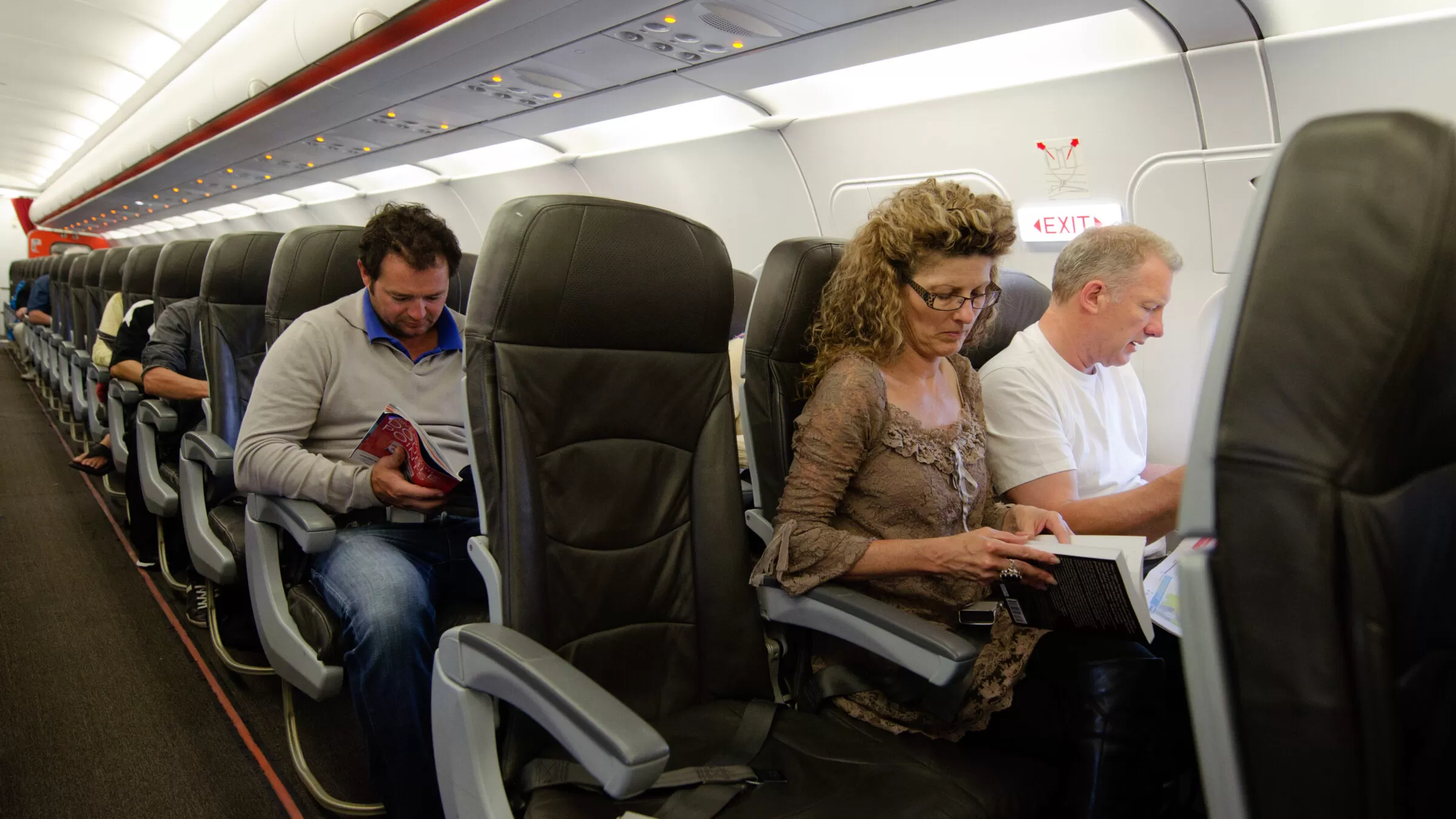
| | Plus: Tyler Cowen on libertarianism now, inflation fears, and more... | | | | | | Are airplanes more dangerous now than they were during the height of the COVID-19 pandemic? No, of course not. Yet that's what CNN implied on Sunday, in an article on "how to fly safely." Correctly noting that the Pfizer and Moderna vaccines are only 90 percent protective against COVID-19, CNN went on to assert (incorrectly) that "translated into reality, that means for every million fully vaccinated people who fly, some 100,000 could still become infected." | | | | | From our partners at The Dispatch | | | It isn’t easy to find journalists today who are honest about where they are coming from. It’s even harder to find true conservative journalists – individuals deeply committed to bedrock conservative principles and who engage opposing viewpoints with honesty and charity. The Dispatch does all of these things. And it does them well. The Dispatch provides engaged citizens with much-needed fact-based reporting and commentary on politics, policy, and culture – all from an unapologetic conservative perspective.
Sign up for The Dispatch here. | | | | | | COVID-19 can and has spread on flights, of course. But even before people started getting vaccinated, confirmed cases of transmission were relatively small. "The risk of contracting coronavirus disease 2019 (COVID-19) during air travel is lower than from an office building, classroom, supermarket, or commuter train," an article in The Journal of the American Medical Association noted last fall. If CNN's estimate were true, that would mean many more vaccinated people getting infected on planes as overall case counts dwindle than unvaccinated people did at the pandemic's peak.
Luckily, CNN's estimate is dead wrong. "NO NO NO. That's not what that number means," tweeted University of North Carolina at Chapel Hill Professor Zeynep Tufekci yesterday, adding "this didn't even happen when millions flew unvaccinated. So how could it make sense now?"
When we talk about a 90 percent vaccine efficacy rate, it does not mean that every single vaccinated person who is exposed to COVID-19 has a 10 percent chance of getting it; individual immune responses and other factors still apply. And it certainly doesn't mean that 10 percent of vaccinated people in the world, a country, or a given place will catch COVID-19.
"What a '90% effective vaccine' means is that the number of people who would otherwise have gotten COVID is 90% lower. It doesn't mean that only 90% of vaccinated people are immune," Australian journalist and University of Technology Sydney fellow Josh Szeps points out.
| | | | | | One million vaccinated people flying does not mean all one million people will be on flights where another passenger has COVID-19.
Even if that were the case, it does not follow that conditions—air circulation patterns, ventilation system operation, masking, proximity to the infected person, etc.—would make it possible for each vaccinated person on a flight to be significantly exposed.
And even if that were the case—the highly, highly unlikely scenario that every vaccinated person is exposed to COVID-19 in-flight—it does not follow that 10 percent of those travelers will definitely catch it. Who catches it upon exposure isn't just a pure percentages game; it also depends on individual immune responses, amount of exposure, and more.
"One common misunderstanding is that 95% efficacy means that in the Pfizer clinical trial, 5% of vaccinated people got COVID," writes Anna Nowogrodzki at LiveScience. "But that's not true; the actual percentage of vaccinated people in the Pfizer (and Moderna) trials who got COVID-19 was about a hundred times less than that: 0.04%."
Reason's Ronald Bailey recently looked "at what a 95 percent vaccine efficacy rate would mean in a hypothetical case in which a population of 100,000 people have all been vaccinated."
"Applying the 1 percent rate at which unvaccinated folks became ill during the vaccine trials over three months suggests that 1,000 people in an unvaccinated population of 100,000 would fall ill," notes Bailey. "But because all 100,000 people are vaccinated, the actual rate in the vaccinated population would be just 50 cases (0.05 x 1,000 = 50 cases)."
The CNN article has since been updated to say that while the vaccines are 90 percent protective, "that means it's still possible to get infected." A correction at the end of the article says "A previous version of this article incorrectly extrapolated vaccine efficacy and the probability of becoming infected with Covid-19 aboard airplanes. The risk is much lower than stated in the original version."
| | | | | | | | Tyler Cowen sketches out a new vision of libertarianism, after declaring last year that the libertarian movement was "pretty much hollowed out." Taking a second look, Cowen asks: "What does it mean to be libertarian now? I would say that the purer forms of libertarianism are evolving: from a set of policy stances on political questions to a series of projects for building entire new political worlds." With many past battles around regulation and communism won, and other old battles seemingly lost forever (health care) or unable to sustain much public interest (anti-war efforts), Cowen suggests that "much of the intellectual effort in libertarian circles is concentrated in two ideas in particular: charter cities and cryptocurrency."
But Cowen's piece ignores many areas where U.S. libertarians have long been focused, continue to focus, and could do real good—for the movement, and for the country more broadly—by focusing even more. Things like ending the drug war (which is arguable just as strong and destructive as ever, despite moving away from marijuana as a target), other criminal justice/police/prison reform efforts, fighting the surveillance state, dismantling oppressive occupational licensing, staving off a bloated and all-powerful antitrust regime, and fighting for free markets and free speech despite major political party figures who increasingly can't stand either, to name a few. And anti-war efforts seem valuable even—or especially—in the face of waning popularity.
Cryptocurrency is great, and charter cities intriguing. But U.S. cities and systems as they exist leave plenty of room for valuable, influential, and perhaps even some winnable libertarian fights, too. Building new political worlds is all good, but libertarians shouldn't give up just yet on the one we have, either.
| | | | | | | | Are we headed for 1970s-style inflation? Reports about current commodity markets are eerily reminiscent of the '70s, The Wall Street Journal says: | | | | In 1973, the U.S. was coming off a two-year experiment in wage and price controls, which artificially depressed prices and muted signals that the economy was overheating. Then, too, the Fed pursued an easy-money policy, keeping interest rates low—though considerably higher than now, and without today's purchases of bonds and mortgage securities….
In 2021 we're emerging from the pandemic shutdown, which cratered growth and slammed the economy—depressing price pressures, not unlike what the price-control program did 50 years ago. Today's Fed policies are even more expansive. And Congress has just enacted a $1.9 trillion stimulus bill—on top of earlier relief bills costing another nearly $2 trillion, a lot of which remains unspent and will continue to fuel demand this year and beyond.
Does that mean that we're doomed to repeat the earlier disaster? Today's fiscal stimulus clearly dwarfs anything even considered in the 1970s. Moreover, there is a palpable excitement that Americans will finally be able to discard the shackles of Covid and spend the money they saved last year and the wages they're starting to earn again. So demand is likely to soar.
As was the case 50 years ago, there are constraints on supplies: shipping delays are blocking deliveries; manufacturers can't get parts to ramp up production; real-estate values are skyrocketing, while lumber shortages constrain home building; and most commodity prices are rising precipitously. Experts reassure us that the annual inflation rate will rise only to about 2%. We hope they're right, but when demand increases faster than supply, prices tend to go up.
| | | | | | | | | | | | | | | | | • The term "'BIPOC' isn't doing what you think it's doing," write Andrea Plaid and Christopher Macdonald-Dennis at Newsweek. | | | | • "The Texas Supreme Court voided a restraining order against a salon owner who was jailed and fined last year for keeping her store open despite executive actions requiring the business to be closed," reports The Hill. | | | | | | | | | Most Popular Stories from Reason.com | | | | | A New Study Finds No Relationship Between Opioid Prescriptions and Unintentional Injury Deaths |
|
| | | | | Elizabeth Nolan Brown is a senior editor at Reason, where she writes regularly on the intersections of sex, speech, tech, crime, politics, panic, and civil liberties. She is also co-founder of the libertarian feminist group Feminists for Liberty.
Since starting at Reason in 2014, Brown has won multiple awards for her writing on the U.S. government’s war on sex. Brown’s writing has also appeared in The New York Times, Los Angeles Times, The Daily Beast, Buzzfeed, Playboy, Fox News, Politico, The Week, and numerous other publications. You can follow her on Twitter @ENBrown. | | | | | | | | | | | | | 
Breaking news from GSA Business Report Click here to view this message in a browser window. ...

-
Search Engine Watch Seven Google alerts SEOs need to stay on top of everything! Posted: 25 Jan 2022...
-
-
| | | |



No comments:
Post a Comment